Research Minute: 3 Industries Where Utah May Face Talent Shortages


Each month, EDCUtah’s Research Minute highlights timely research insights and economic development data. This month, Michael Stachitus analyzes Utah’s potential occupational gaps over the next five years.
As Utah’s population and economy continue to grow rapidly, the demand for specific skills and experience in the workforce only continues to increase. As this demand for labor grows, Utah must be nimble and forward-thinking in its workforce development approach.
EDCUtah analyzed potential workforce demands over the next five years, and we identified three occupations that may become increasingly difficult to fill if current demand and market trends remain the same:
1. Healthcare Diagnosing or Treating Practitioners
2. Computer Occupations
3. Business Operations Specialists
The graph below provides a snapshot of the expected annual supply and deficit in occupations over the next five years. These are broad occupational groupings, with more specific occupations nested within each occupational category.
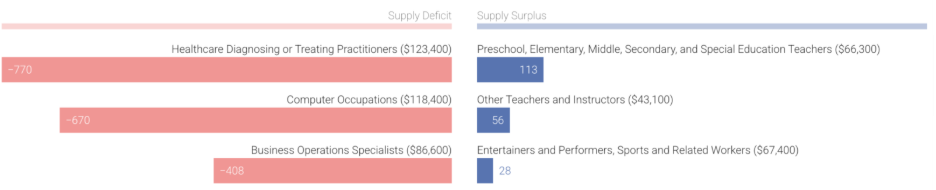
Healthcare remains a critical industry in Utah and continues to face challenges in meeting hiring demands. This challenge is not unique to Utah. The high demand for healthcare workers is a nationwide and potentially even global issue. As the median age in Utah and across the nation increases, healthcare needs are also expected to rise.

The gap leaves Utah with over 300 fewer registered nurses and nurse practitioners than the industry requires each year – which also means that existing nurses and hospital staff will have to shoulder the burden of increasing demand. Furthermore, there’s not a single surplus occupation in this healthcare category, meaning every occupation in the group faces a hiring deficit.
As technology innovation and artificial intelligence (AI) continue to drive economic growth in the U.S., computer occupations remain in high demand. The demand for software developers in Utah has remained high for over a decade and is expected to continue over the next five years.

Utah can address these occupational gaps by fostering strong alignment among workforce development initiatives, educational institutions, and industry needs. This includes investing in targeted training programs, apprenticeships, and certifications that align with high-demand sectors, while encouraging businesses to partner with schools and community colleges to shape curricula around in-demand skills. Utah is addressing these demands through key programs and initiatives, including Talent Ready Utah, Custom Fit, and Return Utah, three programs that connect companies to the workforce they need.
Data Sources: JobsEQ. For more information about occupational gaps, email us at connect@edcutah.org or explore the benefits of investing with EDCUtah.
_____
For additional information or to schedule an interview, please contact us.


Law firm Ogletree Deakins – an EDCUtah Builder’s Circle investor – recently held an employment law briefing and invited EDCUtah to attend. We sat down with Kathleen D. Weron, who has an extensive employment law practice with a focus on occupational safety and health, labor law and litigation, to get the latest updates.
An important note: Ms. Weron stresses that the conversation that follows is not confidential legal advice and that you should seek guidance from your own counsel.
We covered a broad range of Federal and State laws and regulations in the seminar, which I can cover briefly. For me, topics that stand out are the Federal Trade Commission’s (FTC) ban on Non-Compete Agreements, the Equal Employment Opportunity Commission’s (EEOC) guidance on sexual harassment, and changes to the National Labor Relations Board’s (NLRB) approach to “concerted activities” as defined in the Unfair Labor Practice Act.
Not yet. The first thing I’ll tell you is that there’s a lot of misinformation out there. I caution companies not to get their legal advice from headlines.
For one thing, the rule doesn’t take effect until September 4, and it’s the target of two lawsuits, so in all likelihood it’ll be subject to a stay in the federal courts and may eventually get overturned.
But for prudence’s sake, companies should evaluate at their non-compete agreements, their non-solicitation agreements, and their confidentiality agreements, because this is an opportunity to narrow and tighten the language to better withstand challenges in the future. One takeaway here is to separate these agreements into different documents and narrowly tailor them to protect legitimate business interests.
The FTC’s rule effectively bans all non-competes, retroactively and going forward. The rule’s language requires employers to refrain from enforcing most existing non-compete agreements. It also states an employer cannot prohibit, penalize, or prevent a worker from seeking or accepting work in the U.S. or from operating a business. A “worker” is defined as anyone from an executive to frontline employees to independent contractors.
If it goes into effect, employers will be required to send notices to employees who have non-competes, advising the employees that the non-competes are no longer enforceable. Should the rule navigate past the lawsuits, this notice would need to be sent in September 2024.
Yes, there are three. One involves existing agreements with senior executives entered into before the effective date of the rule. A second involves sale-of-business non-competes, and the third involves any causes of action that accrue before the September 4th effective date.
Senior executives are defined as employees in policymaking positions who have annualized compensation over $151,164. Remember to factor in those last $64 dollars—I love how the Feds come up with these very specific dollar criteria!
“Policymaking” is narrowly defined, requiring “final” policymaking authority over more than just a segment of a business. So, it’s only going to cover pre-existing agreements with your most senior leaders.
The FTC’s expanded definition of non-competes may extend to clauses that restrain the solicitation of customers, if those provisions are broad enough to be seen as functionally preventing a worker from seeking or accepting employment. Specifically, a well-drafted customer non-solicitation provision could “prohibit” an employee to reject competitive employment. This is going to be a focus of intense litigation in the near term.
As for trade secret agreements, state and federal trade secret laws remain in place and employers will retain the same rights to protect trade secrets under those laws. If the rule goes into effect, you’ll want to make sure your confidential information and trade secrets are protected outside the context of a non-compete or non-solicitation agreement. In other words, split these things up into separate documents.
Well, there’s something to be said for doing nothing, given the likelihood of a judicial stay.
You can also embrace the future and rewrite your template contracts to remove non-competes.
Lastly, there’s a middle ground, where you retain non-competes for senior leadership and other highly compensated employees. A lot of states are moving in this direction, and I expect Utah will eventually as well.
Currently Utah allows non-competes to have an effective duration of 12 months from the date an employee leaves the company’s employ. If the FTC rule comes into effect, it would supersede the state’s provisions.
The other thing to bear in mind – and a good reason to revisit your template agreements – is that most other states are moving in the direction of limiting use of non-competes. If your business has operations in multiple jurisdictions, keep an eye on each state’s actions in this arena.
First of all, this is the EEOC’s first update to workplace harassment guidelines since 1999, and the language took effect at the end of April. I can give a couple of high points, but I would encourage your human resource experts to dive into the details if they haven’t already done so.
For one thing, the guidance recognizes unlawful harassment against LGBTQ+ individuals, including sexual orientation and gender identification. Second, it addresses working protections for pregnancy, childbirth, or related medical conditions, including lactation. And third, it provides more than 70 hypothetical examples of potential unlawful harassment.
There’s language focused on color—that is, skin tone—versus race or national origin that bears consideration, as well as discussion of “repeated and intentional” misgendering. There’s also language on intraclass and intersectional harassment. For example, a 56-year-old harassing a 65 year old is still harassment, even though the individuals are in the same protected class.
The new guidance also discusses pregnancy-related harassment, which is relevant as the Pregnant Workers Fairness Act became effective in June 2023.
You need to know what’s going on here, even if you don’t have union employees. Section 7 of the National Labor Relations Act (NLRA) grants employees the right to form or join unions; engage in protected, concerted activities to address or improve working conditions; or refrain from engaging in these activities, if they so choose.
Section 8 makes its an unfair labor practice for an employer “to interfere with, restrain, or coerce employees in the exercise of their rights guaranteed in Section 7.”
One emerging area you need to pay attention to involves social media. One employee complaining online about their work or their boss is a personal gripe, and is not “concerted activity.” If other employees engage with that post, such as discussing terms of employment, wages, etc, in the comments, that has been construed as a concerted activity. The NLRB has been ruling in favor of employees in these cases. So, the takeaway here is to make sure you’ve crafted your social media policies so that they don’t interfere with concerted activities.
Two things come to mind. First, the Department of Labor (DOL) has increased the salary threshold for white collar exemptions. It is happening in two stages. In July, the threshold reaches $43,888 per year, and in January 2025, it rises to $58,656 per year. This may significantly increase the number of employees entitled to overtime compensation in Utah and other states you operate in. It calls for auditing your current payroll and has implications for timekeeping and recordkeeping.
Second, with the advent of artificial intelligence (AI) in all aspects of our lives, the DOL has issued guidance about the use of AI. “Responsible human oversight” is key. For example, as more and more companies use AI to screen resumes and to even conduct initial interviews, the company can’t abrogate all responsibility and decision-making to a bot, which may have inherent bias. And the company is on the hook, even though the AI tool may have been developed and administered by a third party. Again, lots to think about!
_____
EDCUtah is Utah’s only statewide economic development organization with a public-private partnership model. When you partner with EDCUtah, you gain access more than 200 local experts in law, real estate, construction, finance, talent recruitment, utilities, and more. Explore our investor network or email connect@edcutah.org to learn more.
For additional information or to schedule an interview, please contact us.