Research Minute: Utah's Cost of Living


The EDCUtah’s Research Minute highlights interesting economic development data and timely research insights. This month, we discuss EDCUtah’s participation in a national cost of living index and how Utah measures up.
When a new corporate expansion or retention project is considering Utah for a business location, EDCUtah’s research team provides several reports to the client. One of these reports, the Operating Cost Comparison, measures the cost of doing business in Utah against other regions being considered by the company. We include wage estimates, real estate prices, utility rates, taxes, and the cost of living index.
Cost of living impacts the decisions of both individuals and companies, and site selection consultants often compare the cost of living in Utah against other states in the region. How does cost of living impact business? In some instances, a higher cost of living in a particular area may mean employers must offer higher salaries to attract and retain workers. Additionally, higher cost of living can translate to higher building costs and operating costs for the company.
Each year, researchers and regional organizations like EDCUtah collect cost of living data and submit it to the Council for Community and Economic Research (C2ER). C2ER compiles the data into a national index that measures cost of living differences among metropolitan areas. We collect price data in six categories: housing, utilities, grocery items, transportation, health care, and miscellaneous goods and services. The average of all locations that collected data that year is set to 100, and regions are then compared as a percentage above or below the average.
Policy impacts pricing! In this quarter’s collection, we noticed that the cost of name-brand insulin is down significantly. This likely reflects recent changes in legislation and the availability of insurance-covered alternatives for those with type 1 diabetes.
Because the cost of living is measured at a specific point in time and the composition of data participants changes slightly each quarter, the index cannot be used to measure price increases over time. However, it is useful to compare regional costs in relation to each other and to the nation as a whole. It’s especially helpful for comparing different regions that may be experiencing similar trends in inflation, housing costs, and more. This index is often cited in national news by outlets including Wall Street Journal, Forbes, CNNMoney, US News and World Report, and ABC News.
C2ER recently published their 2023 cost of living index, which is calculated based on the average of the previous three quarters of data. Salt Lake City received a score of 108.7, St. George 107.8, Provo 103.6, Ogden 99.9, and Cedar City 96.2.

The main reason many Utah metros measure above the national average is the price of housing—which includes both purchase price and apartment rents. The rest of the country has also seen rapid increases in housing costs, and housing costs continue to be a pain point for states including Utah, Idaho, Arizona, Washington, and Colorado.
Utah’s index scores are similar to or lower than the index scores of markets we often compete with. The index score for Miami is 116.9, Denver 110.3, Reno 104.4, Phoenix 101.9, Austin 98.9, Atlanta 98.3, and Charlotte 96.5. Utah metro areas are competitive in terms of affordability and provide a balance between costs and quality of life.

EDCUtah recently finished our first quarter data collection for four Utah metropolitan statistical areas (MSAs): Salt Lake City, Provo-Orem, Ogden-Clearfield, and the St. George metros. In the past, EDCUtah collected local data for the Salt Lake, Ogden, and Provo metros, but we recently added the St. George metro due to process developments that allow data to be collected remotely. Previously, grocery prices were collected by walking through each store—five stores per metro—and writing down prices. As grocery delivery services became more prevalent over the last few years, this data became more widely available online, which allows for web scraping.
One of the competencies that sets EDCUtah apart from other economic development organizations is our focus on quality research and economic data. Not only do we provide reports that inform decision-makers as they evaluate Utah for their next business location—we also represent Utah communities in valuable data collection projects that contribute to economic benchmarking.
_____
Want more data? Explore the benefits of investing with EDCUtah.
For additional information or to schedule an interview, please contact us.

The Utah Inland Port Authority (UIPA) is developing strategic and sustainable logistics-backed economic development solutions to enhance the lives of Utahns and establish Utah as a global industry connector. In 2023, Jaime Hernandez joined EDCUtah as the UIPA project manager, a new role on the business development team created by a partnership between EDCUtah and UIPA. In this role, Jaime manages corporate expansion and recruitment projects for UIPA sites.
In this Q&A, Jaime spoke with UIPA executive director Ben Hart about the impact of the Port Authority on Utah’s economic development.
Ben: Our premier area encompasses the 16,000 acres near the Salt Lake City International Airport in Salt Lake County, but we have sites across the state and bring to market the best of what the state can offer. We’re going to be – and have been – aggressive in site development. Part of this effort is based in helping communities around the state identify what their economic development priorities are and helping them achieve those goals. On the other side of the equation, we are and will be showcasing sites that site selectors and companies will find very attractive, all across Utah.
There are examples from the northern, central, southern, and western parts of the state. In the north, Box Elder County’s project area is seeing the construction of Lakeshore Learning’s assembly and distribution center. That’s a 1.2 million-plus square foot facility that will employ 540 workers. We were able to help the local government put together a compelling incentive that landed that opportunity.
In central Utah, we’ve been working with Northrop Grumman here in Salt Lake City. That incentive has landed. And we’ve been working with other companies to make sure they have good rail access for their operations in the Northwest Quadrant.
In southern Utah, BZI Steel in Cedar City will be hiring up to 800 people, and the company will now be able to get its product shipped right out the door via rail. At the same time, we’re able to help get their site built out with additional infrastructure needs. And in the west, we have a couple of projects underway in Tooele.
All these sites represent a diverse offering we can present to site selectors and companies.
Ben: UIPA is currently collaborating with a company called CPCS to improve Salt Lake City and Utah’s logistics infrastructure. Their efforts include analyzing commodity flows, assessing current infrastructure, and formulating logistics strategies on both regional and statewide levels. This plan aims to enhance road and rail systems for better freight movement, perform SWOT analyses in strategic areas, and map out commodity flows. CPCS will also build essential partnerships, engage with communities via open houses, and provide in-depth analyses and strategies for logistics enhancement. Additionally, they will develop tools for continuous analysis and stakeholder engagement.
This is going to be part of our value proposition for the state for the next 20 to 30 years. Right now, Utah is heavily dependent on road-based transportation. Our goal is to make rail a more viable option across Utah. That means better access, better pricing, and better service.
We’re also looking at the air transportation component, including drone delivery services in advance of the 2034 Winter Olympics if we are lucky enough to get them.
Overall, Utah has very strong international and regional airports, we have great road access with I-80 and I-15, and we have unique rail capabilities as well. We want Utah to become the logistics capital of the United States, but we won’t get there just by using roads. We’ve got to have multi-model capabilities. When you bring all those things together, as the planning process will help to do, Utah will have a full suite of options for those companies with sophisticated logistics needs.
Ben: The Inland Port gives Utah a significant advantage when it comes to attracting, recruiting, and helping businesses to expand. Two of the most important capabilities we provide to site selectors and companies are: 1) streamlined incentives that incorporate all the downstream taxing entities, and 2) assistance with infrastructure development through our infrastructure bank.
There’s a speed-to-market element here. We focus on industrial property, and when you’re talking about three percent vacancy in those properties nationwide, it’s really a question of how fast you can get new buildings vertical. We work with local officials to help businesses get through permitting and entitlement processes, put together solid incentive offers, and lastly, help with infrastructure where needed – all these aspects are part of the value we bring.
Ben: We’re really pushing for industrial projects. We’re trying to incentivize and target advanced manufacturing companies first and foremost. That will naturally lead to warehouse distribution as a secondary follow-on.
Our project areas, each with unique characteristics, are designed to attract diverse industries such as logistics, manufacturing, agriculture, and technology. These areas leverage their geographical advantages and resource availability to support economic activities tailored to their specific strengths and local infrastructure.
Ben: We’ve got a fully capitalized $65 million infrastructure bank that gives us the ability to create public financing options very quickly. The bank uses a tax increment approach for funding.
We’re trying to remove barriers, whether that’s lining up permits, or getting incentive packaging on the table quickly, or public financing options – those are all things that we can expedite. Our whole pitch with “speed to vertical” is that we can shorten the time needed in any of those key needs.
UIPA has an incredible toolkit to support businesses looking to expand or locate within one of our project areas.
In Utah, we have the Authority Act, which facilitates the use of tax differential in specific project areas, guided by local statutes and our project area plans. This includes funding for affordable housing, development of land and intermodal facilities, public infrastructure, and environmentally friendly construction. Additionally, we can provide funding in our project areas through the Authority Infrastructure Bank (AIB). Typically, the AIB will focus on projects that generate revenue and serve the public interest, aligning with long-term economic growth objectives.
This comprehensive approach, encompassing bank loans, area incentives, and tax differential reinvestment, supports businesses in achieving strategic and sustainable development goals in Utah.
Ben: The Port incentives are coming from the local property tax increment. They can be layered with the State’s incentives offered by the Governor’s Office of Economic Opportunity. So, we can put attractive, “stacked” incentive deals on the table, hand in glove with the State.
This means the site selector or company doesn’t have to negotiate with every tax entity. We can work with all those tax entities in a streamlined way to provide the client with one contract process through the Inland Port. In other words, they don’t have to go work with a bunch of other downstream tax entities. Again, we’re able to streamline the entire process.
Ben: Today, we can implement Infrastructure Bank loans, incentive processes, and other public financing tools in 60 to 90 days, in contrast with a lot of jurisdictions across the country where those processes might take two to three years, particularly when you’re negotiating with downstream tax entities. Our board can turn around decisions that quickly.
In terms of construction, permitting-, and entitlement-support timelines, it varies by location. With that said, we stress to our communities that they need to be ready for development. Those are things we’re working on now. For example, we’re having infrastructure conversations upfront, so these sites are more ready for development.
Some project areas are further along the process while others are still in a greenfield state. The Northwest Quadrant has some buildings already, while other locations need more work to get to site-ready status. For example, Cedar City is dialed when it comes to logistics, but has some other needs. They should be ready to start building within the year.
Ben: It’s a little bit of everything. For example, at the Global Logistics Center in the Northwest Quadrant, they can support the entire design and build process, or they can lease a company acreage and the company can bring in their own construction resources.
Ben: We’re thrilled about working closely with EDCUtah. It’s a game-changer for us and the wider community. EDCUtah is key to helping us boost economic growth across the state and connect more deeply with our communities. Together, we’re focusing on bringing in new businesses by tapping into EDCUtah’s strengths in business development, community strategy, and site selector marketing. This partnership is about making Utah a standout place for logistics and tech, all while looking after our beautiful state.
It’s more than just a partnership; it’s a powerful way to make sure our efforts really count, boosting Utah’s economy and making life better for everyone here. We’re on the same page about making a big, positive splash, and honestly, I can’t wait to see where this collaboration takes us.
_____
“Building Together” highlights examples of the collective impact of EDCUtah and our investors in communities across the state. Do you have a story you’d like us to share? Email connect@edcutah.org.
For additional information or to schedule an interview, please contact us.

510 jobs
25,000 sq ft.
$26 million capex
Project Sew
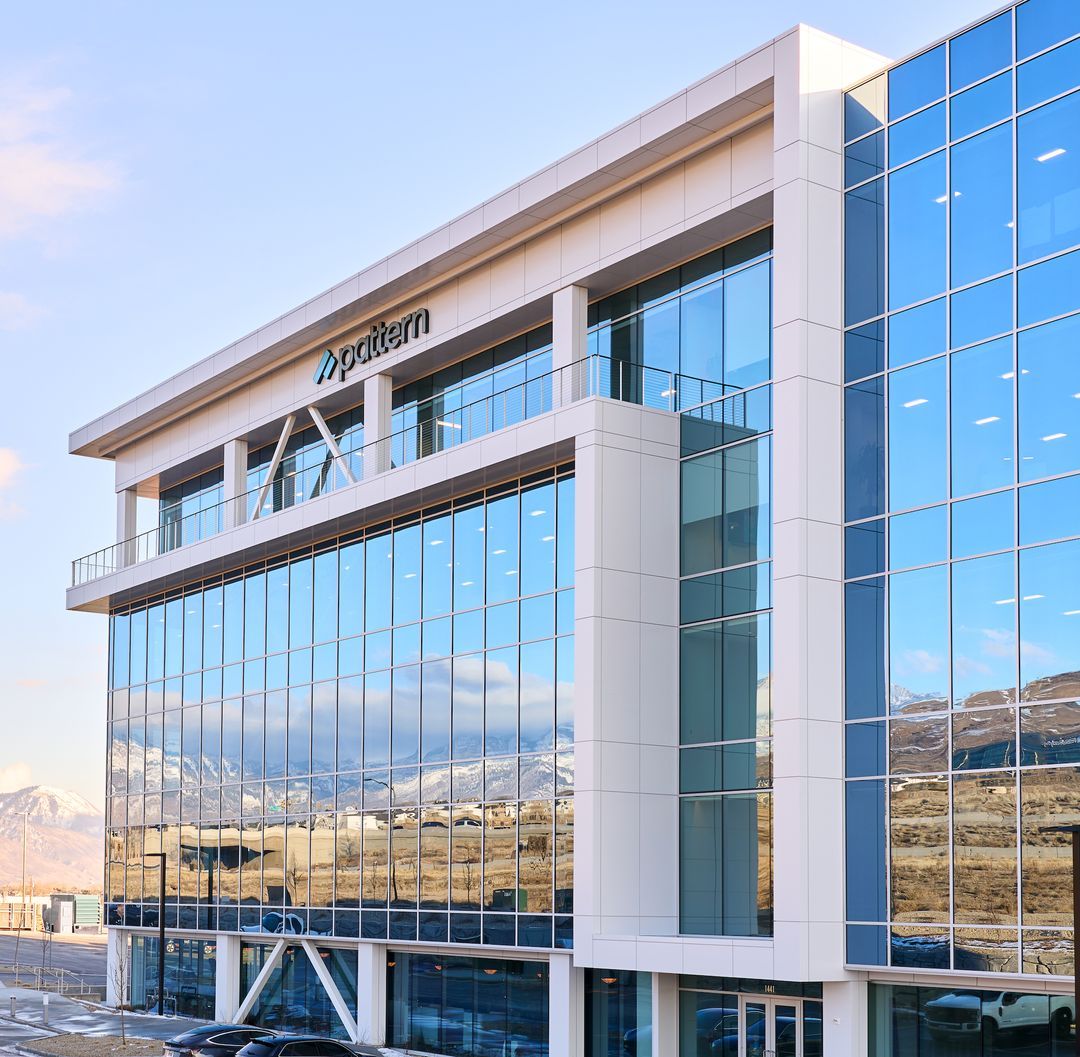
Today, the Utah Governor’s Office of Economic Opportunity (GOEO) and the Economic Development Corporation of Utah (EDCUtah) are pleased to announce that Pattern plans to bring more than 500 high-paying jobs and invest nearly $26 million in Utah over the next 10 years.
“The global expansion Pattern has achieved since its beginnings here in Utah is remarkable, and we’re pleased about the addition of hundreds of new jobs to its home base,” said Ryan Starks, GOEO executive director. “Pattern continues to set the standard for market leadership and showcases the potential our Utah companies have in creating a positive impact on both the local and global economies.”
Pattern is the leader in global e-commerce and marketplace acceleration. Hundreds of global brands — including Bosch, Nestlé, Stance, TUMI, and Panasonic — rely on the company’s e-commerce acceleration platform to grow their online sales on direct-to-consumer websites, online marketplaces, and other digital channels in more than 60 countries, all while managing fulfillment and logistics.
“Utah continues to be a key component in our long-term growth strategy,” said David Wright, co-founder and CEO at Pattern. “We love the incredible talent pool, vibrant business climate, and world-class outdoor entertainment in the Beehive State. We can’t think of a better place for our global headquarters and look forward to another decade of growth.”
“Approximately one-third of EDCUtah’s active projects are Utah companies looking for their next business location, and it’s great to see another homegrown tech company stay and grow in Silicon Slopes,” said Scott Cuthbertson, president and CEO of EDCUtah. “Pattern is a market leader for global e-commerce and marketplace acceleration, and its expansion is a great win for Lehi and the surrounding community.”
“Pattern exemplifies the type of technology company that Silicon Slopes is named for in the heart of Lehi,” stated Marlin Eldred, economic development director at Lehi City. “As a global leader in e-commerce, Pattern is changing the way companies are doing business. This exemplifies the entrepreneurial spirit that the Utah technology sector is built on. Lehi City as a partner is excited to see the Governor’s Office of Economic Opportunity incentivize Pattern to expand and stay in our city.”
Erin Farr, vice president of business development, led Project Sew for EDCUtah. Colliers provided brokerage services to the client.
_____
For additional information or to schedule an interview, please contact us.

190 jobs
339,000 sq ft.
$237 million capex
Project Merlin
Today, the Utah Governor’s Office of Economic Opportunity and the Economic Development Corporation of Utah (EDCUtah) announced the establishment of a 339,000 sq. ft. baking facility by Nature’s Bakery in Salt Lake City. Nature’s Bakery projects to add over 190 jobs to its Utah location and invest $237 million in the Utah facility.
“We offer a warm welcome to Nature’s Bakery, a producer of wholesome, plant-based food that aligns with our state’s health-conscious lifestyle and love for outdoor activities,” said Ryan Starks, executive director of the Utah Governor’s Office of Economic Opportunity. “With Utah’s strong emphasis on well-being and sustainability, Nature’s Bakery’s offerings are poised to resonate with our communities. We look forward to the positive impact it will bring to our local economy, the creation of many jobs, and contribution to the flourishing food culture in Utah.”
Founded in 2011 and headquartered in Reno, Nevada, Nature’s Bakery, part of Mars, Incorporated family of brands, has become the eighth best-selling and fastest-growing granola and snack bar brand in a +$4B category. Nature’s Bakery bakes the goodness of real ingredients into convenient, on-the-go snacks that are plant based, dairy-free, nut-free, and Non-GMO Project Verified. Their products are sold nationally at Target, Walmart, Costco and more, across 100,000 stores and counting.
“I am thrilled for our strategic expansion with the establishment of a cutting-edge baking facility in Salt Lake City,” shared Steve Gardiner, CEO of Nature’s Bakery. “This investment marks a significant milestone in our brand’s ability to drive greater capacity to meet growing consumer and retailer demand. As a self-manufacturer, this facility joins our existing bakeries to reflect our commitment to innovation and quality, and underscores our confidence in the thriving business environment of Utah. We look forward to contributing to the local economy, cultivating community, and creating job opportunities as we further our brand purpose of nourishing families and enabling them to thrive.”
To accelerate the growth of their better-for-you snacking platform, Nature’s Bakery has been part of the Mars family of companies since 2020. “This investment symbolizes our dedication to scaling our brands responsibly, upholding Mars’ pledge to be America’s prime destination for insurgent brands,” shared Juan Martin, Health & Wellness president at Mars, Incorporated.
“Nature’s Bakery’s investment is a reflection of Team Utah’s collaborative and thorough recruitment process, and we appreciate the close involvement from Utah’s community partners and utility providers,” said Scott Cuthbertson, president and CEO of EDCUtah. “We look forward to continuing to partner with Nature’s Bakery as they grow and prosper in Salt Lake City.”
“Salt Lake City is a premier destination for business, and we’re happy to welcome Nature’s Bakery to the community,” Salt Lake City Mayor Erin Mendenhall said. “With over 190 new high-quality jobs, businesses like Nature’s Bakery, which support the needs of our workforce, are an important part of growing the economy for our families. This is a win for Salt Lakers and everyone who loves to live, work, and play here.”
Nature’s Bakery’s new facility is scheduled to initiate operations in July 2025.
Katherine Morrell-Moser, senior business development manager, led Project Merlin for EDCUtah. Chris Liddell and Tom Dischmann, both of CBRE, facilitated the property sale.
For more information about Nature’s Bakery, contact Hanna Teklu, senior director of marketing communications, at hteklu@naturesbakery.com.
Investors: If you were involved in this project and would like to add your organization to this announcement, please email connect@edcutah.org.
About Nature’s Bakery
Nature’s Bakery believes that simple, wholesome snacks are the best fuel for active, joyful lives. Since 2011, they’ve soft-baked the goodness of real ingredients like sun-ripened fruit and hearty whole grains into snacks that are plant-based, nut-free, dairy-free, gluten-free, and Non-GMO Project Verified. Nature’s Bakery products include Whole Wheat Fig Bars, Gluten Free Fig Bars, Oatmeal Crumble bars, Organic Baked-Ins bars, Brownie bars, and Fig Bar Minis. Nature’s Bakery products can be purchased online at naturesbakery.com and Amazon. For more information, please visit naturesbakery.com/press-room or join the conversation on Instagram, TikTok, and Facebook.
About Mars Incorporated
Mars, Incorporated is driven by the belief that the world we want tomorrow starts with how we do business today. As a global, family-owned business, Mars is transforming, innovating, and evolving to make a positive impact on the world. Across our diverse and expanding portfolio of quality snacking, food, and pet care products and services, we employ 140,000+ dedicated Associates. With more than $47 billion in annual sales, we produce some of the world’s best-loved brands including Nature’s Bakery®, Ben’s Original™, CESAR®, Cocoavia®, DOVE®, EXTRA®, KIND®, M&M’s®, SNICKERS®, PEDIGREE®, ROYAL CANIN®, and WHISKAS®. We are creating A Better World for Pets through our global network of pet hospitals and diagnostic services – including AniCura, BANFIELD™, BLUEPEARL™, Linnaeus and VCA™ – using cutting edge technology to develop breakthrough programs in genetic health screening and DNA testing.
_____
For additional information or to schedule an interview, please contact us.

100 jobs
$4 million capex
Project Gemini
The Utah Governor’s Office of Economic Opportunity and the Economic Development Corporation of Utah (EDCUtah) are pleased to announce that Procter & Gamble Paper Products Company (P&G) plans to bring at least 100 new high-paying jobs to rural Utah during the next 20 years. Capital expenditures associated with the project are $400 million.
“Procter & Gamble is a well-known company with brands that are in almost all Utah households,” said Ryan Starks, executive director of the Governor’s Office of Economic Opportunity. “We’re excited they have decided to expand in Box Elder County, and we wish the company success as they continue to grow.”
P&G is a multinational corporation that manufactures consumer products in countries throughout the world. The company produces products in the cleaning, laundry, paper, beauty care, and health care segments. P&G’s brands have been trusted in millions of living rooms, kitchens, laundry rooms, and bathrooms for generations. For over 180 years, the company has committed to making people’s lives better in small but meaningful ways.
The Procter & Gamble Box Elder facility was established in 2010 and has expanded multiple times. It currently operates on approximately 750 acres of land, with over 40 acres under its roof. Today, over 500 employees work at the site supporting the company’s efforts across P&G’s Paper, Baby Care, and Feminine Care businesses.
“We are excited to expand our operations in Box Elder County to meet the growing demand for our products and serve our consumers,” said Seth Garner, senior director of Product Supply Manufacturing, Box Elder Plant. “We’re grateful to the Box Elder County community, a place we have called home since 2010, for their continued support, and we look forward to many years of partnership and growth.”
P&G may receive up to 10% of the additional state taxes it will pay over the 20-year life of the agreement in the form of a Utah Legislature-authorized Rural Economic Development Tax Increment Financing (REDTIF) tax credit (U.C.A. 63N-2-106(2)). Each year P&G meets the criteria in its contract with the state, it will qualify for a portion of the total tax credit.
“We are thoroughly impressed by Procter & Gamble’s continued investment in Box Elder County and their commitment to being a world-class corporate citizen,” said Scott Cuthbertson, president and CEO of EDCUtah. “The company’s ongoing diligence in resource stewardship and quality job growth makes them an ideal partner in Utah’s goal for economic prosperity.”
Stephanie Pack, senior business development manager, led Project Gemini for EDCUtah.
_____
If you were involved in this project and would like to add your organization to this announcement, please email connect@edcutah.org.
For additional information or to schedule an interview, please contact us.