Research Minute: Utah Ranked No. 1 for Social Mobility


Each month, EDCUtah’s Research Minute highlights interesting economic development data and timely research insights. This month, we explore the Archbridge Institute’s Social Mobility score and how Utah earned the no. 1 rank in the country.
Utah ranks first in the nation for social mobility in the 2023 Social Mobility in the 50 States report published by the Archbridge Institute. For residents, this translates to a better chance of moving up the social and economic ladder in Utah than in any other state. For businesses, this makes Utah an attractive location because it gives their workforce the best opportunity to live the American dream.
Social mobility has typically referred to the ability of individuals to surpass the earnings of their parents at the same age. In their research to create a social mobility index, the Archbridge Institute included not only this intergenerational income element, but also metrics that more broadly measure one’s ability to improve their life and well-being. Archbridge Institute applied four pillars to the index:
Archbridge Institute analyzed each pillar for all 50 states and ranked them by their scores. Utah ranked no. 1 for overall social mobility, no. 4 for Entrepreneurship and Growth, no. 5 in Education and Skills Development, no. 8 in Social Capital, and no. 17 for Institutions and Rule of Law.
Each of the four pillars contained additional subcategories of measurement. While the report does not give detailed descriptions of the specific data used to generate the rankings, they can still provide insights into general areas of strength and improvement. The subcategories where Utah showed its greatest strengths were:
Utah’s lower rankings appeared in the following subcategories:
While there is room for improvement in Utah’s social mobility, it should be noted that even Utah’s lower rankings just barely fall in the bottom half of all 50 states. Utah is not far from sitting in the top half for all subcategories.
But how does the Archbridge Institute index compare to more traditional measures of social mobility? The index aligns closely with income mobility, poverty rates, and income inequality data for Utah. In a 2014 study, for example, Salt Lake City had the highest score for intergenerational mobility out of the 50 largest community zones in the country. Additionally, Utah has the nation’s second lowest poverty rate (9%) and the lowest level of income inequality as measured by the Gini Index. (Both of these Utah data comparisons use the U.S. Census Bureau’s 2023 American Community Survey 1-Year Estimates.)
Utah has proven to be a place where individuals can increase their income potential and also improve their overall standard of living and well-being. Utah is a place where people want to work, and where companies can have a meaningful impact on the lives of their employees and on the communities where they operate. Doing business in Utah not only makes financial and logistical sense for companies – it makes financial sense for employees, too.
_____
For additional information or to schedule an interview, please contact us.
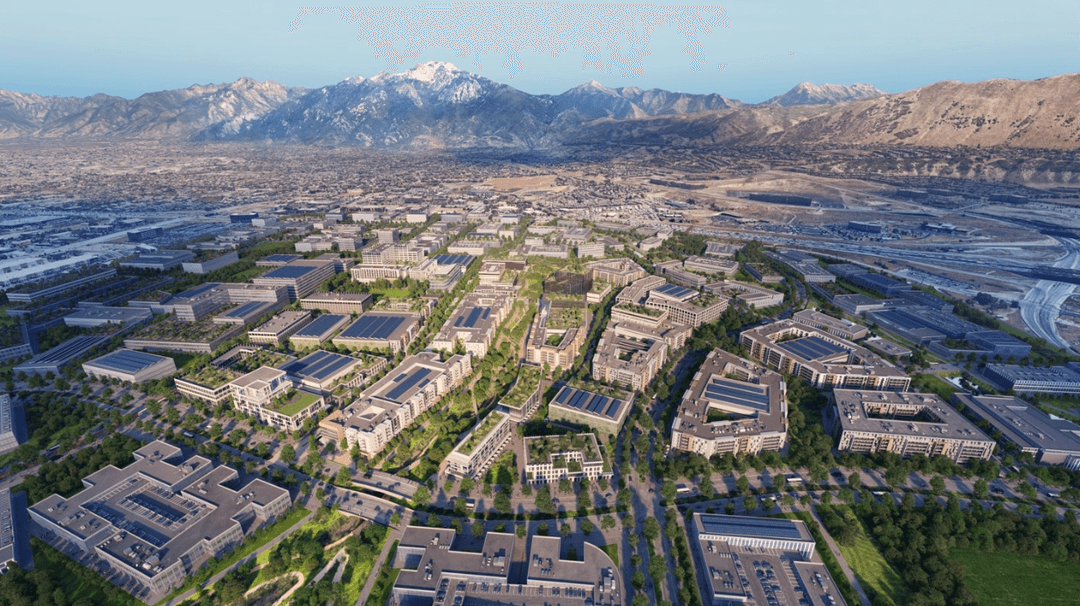
Recognized as one of the most important economic opportunities in Utah’s history, The Point consists of 600 acres of state-owned land that is being built into Utah’s Innovation Community.
The Point of the Mountain State Land Authority (Land Authority) and their private-sector master developer The Point Partners (comprised of partners Lincoln Property Company, Colmena Group, and Wadsworth Development Group) recently signed an agreement for Phase 1 development. The first 100 acres will include a walkable promenade; Central Green; regional trail connections; transit-oriented development; a balanced mix of jobs, housing, retail, shopping, entertainment; and more.
In this Q&A, Alan Matheson, executive director of the Land Authority, and Scott Cuthbertson, president and CEO of EDCUtah, share their thoughts on the project.
Scott: The Point is going to be the largest corporate campus between Salt Lake City and Utah County, offering an urban setting with a great laborshed. It’s a reasonable drive to the airport and it’s in the heart of Silicon Slopes, a thriving national tech hub.
Unlike private-sector developments with multiple owners, The Point is owned by the State. As a result of a robust process to gather input from the public on what they’d like to see at the site, there are ambitious goals in place around walkability, sustainability, innovation, open space, housing, and economic opportunity. For a company that’s looking to attract a lot of talent, The Point is where that talent can live, work, and play—surrounded by great amenities.
Alan: The Point is a premier location in a premier state, and it has a compelling and achievable vision to build on Utah’s advantages. That vision is based on sophisticated analysis, creative planning, and input from thousands of Utah residents—16,000 people to date. We have the advantage of being a blank canvas, so we can achieve the vision more easily than redeveloping an already developed site.
Any smart investor is looking for proven and sustainable returns. That’s Utah, with our economy, workforce, lifestyle, and sound, business-friendly public policies. At The Point, we want to reflect the best of Utah.
Alan: We advance State initiatives and priorities, so we’ll focus on the State’s targeted industry clusters, including life sciences, energy, technology, and aerospace & defense. But it won’t be limited to those areas. We welcome all companies that will be a good fit, and we recognize that there is real value in finding innovation at the intersection of different industry types.
We’re creating a place that will bring together people of different backgrounds to share ideas and find solutions. All aspects of this project are focused on doing things in better ways. We’re working very closely with the Utah System of Higher Education to bring academia and the private sector together to create, nurture, and commercialize ideas that generate economic development and solve some of Utah’s greatest challenges.
Scott: This innovation aspect will be appealing to site selectors and companies. The Point will be a place where companies can join a dynamic ecosystem of innovators, entrepreneurs and educators. It will be a great place to create and commercialize ideas.
Alan: Businesses want a site that’s easily accessed by employees and customers, and well-connected to its region. That’s happening here. FrontRunner—the commuter rail line that extends from Ogden to Provo—will have a new station immediately adjacent to the site, along with upgrades that will make FrontRunner more efficient throughout the system.
In addition, light rail will connect to FrontRunner, go through The Point, and on to Utah County. A mobility plan is under development to allow people to move around the site conveniently. This includes a circulator and apps that will help you find the easiest and least expensive way to get around The Point. With these strategies, this site will be very connected to the region.
Beyond that, the State is investing in and working with our utility companies to install critical backbone infrastructure—roads through the project, water, sewer, electrical, gas, fiber, and everything else that’s needed for a successful community.
And we’re not just looking at the infrastructure we need today. We are planning for a potential vertiport as advanced air mobility continues to develop as a viable transit option.
Alan: This will be one of the premier shopping areas anywhere in the West. The Promenade will be a walkable street with ground-floor retail and residential and commercial space. There will be an event center. Convergence Hall, probably the first building constructed, will be the innovation heart of the project. It’s being designed and programmed right now by The Point Partners and the Utah System of Higher Education.
I’m also really excited by the River-to-Range Trail, a multi-use trail that will connect the Jordan River Parkway to the regional trails east of Interstate 15 (I-15). It will be a critical link connecting the most expansive trail system west of the Mississippi. People will love it for recreation and for active transportation—commuting on their bikes or e-bikes.
“We think placemaking and business attraction go hand in hand. Businesses want the best talent, and the best talent wants to live in the best places. We’re building a place that will attract the workforce of today and tomorrow.”
Scott: I’m excited about the concept of live-work-play. You’ll have your needs met locally, and your family can probably do fine with only one vehicle in the garage for those occasional longer-drive needs.
I also like the emphasis on open space. Lots of green space is programmed throughout the project. It will be exciting for you, on your lunch break, to take a quick mountain bike ride in the nearby hills.
Alan: Demolition on the site is now complete. That creates a blank canvas on which to build. The plan is to start the backbone infrastructure in the spring of 2024. That will include key roads, such as connections to I-15 and Bangerter Highway, and electrical, gas, water, sewer, storm water, and so forth.
The Point Partners will then identify parcels to develop within Phase 1—the first 100 acres. We expect to get their first applications in the fall of 2024, and that they’ll be able to start site work and vertical construction in 2025.
We expect Phase 1 development will entail a combination of build-to-suit and spec construction, including office, residential, retail, and entertainment. We’ll probably see the first occupancy in 2027. From there, it’s just going to take off.
Phase 1 will be outstanding, and most business development opportunities will be able to fit within its framework very well. We also imagine opportunities that will come along that fit better outside of Phase 1—think of sub-campuses within the remaining 500 acres. We have a process in place so that The Point Partners and the Land Authority can work together to support those opportunities.
Scott: We will market the product to our network of site selectors nationwide and to decision makers in certain international markets. Using our in-house research and marketing teams, we can help augment the efforts of the team at The Point and coordinate with the master developer. Lastly, we can help companies navigate the State’s incentives program run by our partners at the Governor’s Office of Economic Opportunity.
Alan: EDCUtah is a valuable and valued partner. They have the team, the resources, and the relationships to share the opportunity The Point represents. EDCUtah can facilitate that important connection between companies and place.
Scott: Our mission is to catalyze strategic economic opportunities and quality jobs in Utah, and that’s what The Point is all about. The Kem C. Gardner Institute forecasts that, at the end of the buildout of the project, The Point will bring 46,000 jobs, $4.5 billion in annual earnings, and $7 billion in annual GDP. In short, this is going to be a key economic hub for the state, and our stakeholders care a lot about seeing that kind of prosperity.
Alan: As a State project, The Point is designed to provide benefits for all residents. In part, that’s the economic activity Scott mentioned and the new tax revenues that can fund priorities such as infrastructure, social services, and education throughout the state. It’s also about creating opportunities for businesses that care about Utah and will invest in our communities.
Ultimately, it’s about investing in Utahns’ quality of life. The Point will be a place where anybody can come with friends and family to enjoy a bike ride or a stroll in a beautiful outdoor area, interact with public art, get something to eat, or enjoy a concert or performance. We think it will be a great gathering place for all. The Point will be known globally and loved locally.
_____
“Building Together” highlights examples of the collective impact of EDCUtah and our investors in communities across the state.
For additional information or to schedule an interview, please contact us.