Building Together: America First Credit Union and Utah’s Business Environment
April 2, 2026
Did you know that two of the nation’s 10 largest credit unions are located in Utah? From maintaining one of the largest branch networks in the country to investing millions in local safety nets, America First Credit Union is deeply rooted in Utah’s economic story.
Founded in Salt Lake City in 1939, AFCU was originally chartered as Fort Douglas Federal Employees Credit Union. Today, AFCU is the sixth largest credit union in the United States, with $23 billion in assets and more than 1.5 million members.
We caught up with Brett Christensen, chief lending officer, to learn about the Utah business climate and the “business of winning.”
As a large financial institution, how does America First view its role in supporting the Utah's economic development?
We have a presence in Utah, Nevada, Arizona, Idaho, New Mexico, and California, but about 60 percent of our members and our business is located in Utah. We view it as very important.
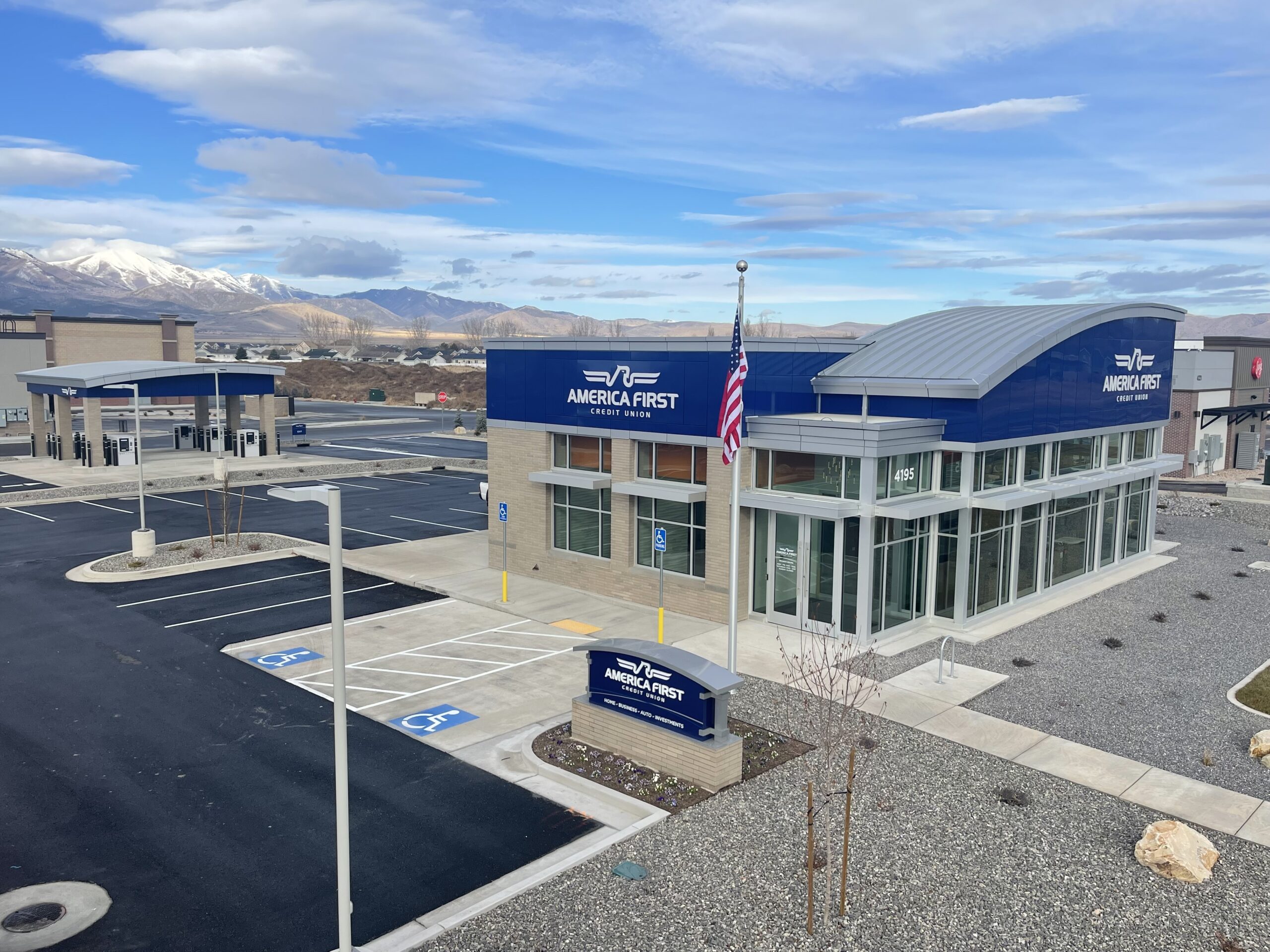
Not only are we one of the largest credit unions in the country, we have one of the largest branch networks, with 116 locations. Branch offices support our presence in the community.
Branches have changed over time. We don’t have all the thousands and thousands of transactions at the teller window like we did in the past. A lot of that's done online and through mobile applications now. But when people have a problem, or they want to open an account, or they want to get a big loan, they still want an in-person presence. And so, we’re always evaluating how we can maximize our branches in our areas, and how we can help to develop the communities where our members live.
Can you share examples of how America First has partnered with local organizations, developers, or municipalities to advance community or commercial projects?
We take our commitment to the community seriously, and that shows up best in the local organizations we choose to support. For instance, we’ve partnered with YCC Ogden by donating $500,000 to help build transitional housing for those escaping domestic violence. We also invested $250,000 in the Fullmer Foundation’s youth boxing arena, which provides a free after-school haven for underprivileged youth in Salt Lake.
Our support extends to specialized care and education as well; we donated $1 million to Primary Children’s Hospital in Lehi to support their school zone and pantry, and $600,000 to Make-A-Wish Utah for the expansion of their Salt Lake facility. We also focused on accessibility and housing by giving $25,000 to the Ronald McDonald House SLC for ADA updates and providing $100,000 to establish Teen Centers in Weber and Davis Counties. These centers offer homeless students a safe place to shower, do laundry, and use computers to keep up with their schoolwork. By teaming up with these dedicated developers and municipalities, we aren't just donating money. We’re helping build the infrastructure our neighbors need to thrive.
What percentage of your portfolio is business-related versus individual member-related?
We started 84 years ago with a focus on consumer banking. The next step was mortgage lending, and then the next step after that was commercial and business lending. Today, our business is about 64 percent consumer, 26 percent mortgage and 10 percent commercial.
We’ve got 88,000 business accounts and a portfolio of $1.7 billion in commercial loans and Small Business Administration (SBA) loans. We're one of the largest credit union SBA lenders in the country.
We're acquiring a bank in the next few months out of Las Vegas, and that'll increase our commercial and business opportunities. Once we complete that acquisition, we'll have about $3 billion total in business loans, and it'll be about 18 percent of our portfolio. So supporting businesses is a growing part of our business, and a very important part.
How does America First balance its commitment to individual members with the financial needs of growing businesses?
We’ve actually grown business lending and business deposits at a faster rate than our consumer side. Many of our consumer accounts are people who are business owners. We've already gained their trust with consumer activities, and it's a natural transition for them to bring their business accounts to us. And many of what were initially business accounts, well, those people bring their consumer lending here for much the same reason.
When we analyze the value of a member account or a business account, we include all the consumer and the business activities. We consider those mixed business and consumer accounts to be some of our most valuable. We continue to grow our products and services to meet the needs of larger businesses.
What are you seeing in Utah’s business climate?
The economic metric that touches us the most is employment numbers. When people are feeling good about their jobs and their incomes, then they're borrowing more, and that helps us on the loan side. When they're doing well with their jobs and their incomes, then they're able to pay their loans on time, and that helps us on the collection side.
I wake up most mornings feeling very fortunate that 60 percent of our business is in Utah, because Utah has done very well economically. When you look at growth rates of businesses, growth rate of the population, unemployment rates, growth in income, delinquency or losses of different loan types, and so on, Utah is generally in a very favorable spot. Utah often ranks in the top five out of 50 U.S. states in about every metric you look at.
We certainly view that as a wonderful advantage to be headquartered, and have the majority of our business, in a state that's doing so well. We can't take it for granted. We still have to work hard and make good business decisions as we manage the business. But we know that the state has done very well economically, and we're thankful for that.
Utah’s workforce is a key component of our economic success. How does America First invest in its own employees and the broader workforce?
We have around 3,600 employees. Training them, keeping them, and providing a meaningful career path for them is a big part of our program.
I think we do better than most at it, based on the amount of longevity that I see. We're big enough that people can grow into positions over the course of their careers. For example, we have a senior management team of about 40 managers and vice presidents, and I would say the average tenure in that room is 20 to 25 years. We also bring in quite a few students, in intern programs and part-time teller positions, and work them up through the organization.
We work hard to build a culture that’s family oriented. We let people know that work is important, but also their personal life and their personal time is important to us. We want them to have a good work-life balance. It's worked out well for us as an organization.
How is technology transforming your approach to community banking and business services in Utah?
To stay relevant, especially for younger members and businesses – it's all technology-driven. Just look at the fintechs, the financial technology companies that are out there. They're growing like crazy, and it's because they have great tech.
As important as technology is, we've learned that having a person-to-person relationship, with a member or business owner, can go a long way as well. Our goal as an organization is to become that hybrid of a financial service provider with great technology that you want, expect and deserve, and also have an exceptional human service element.
We're growing 8 to 10 percent a year, and a big part of our strategic plan is improving in technology. One example is on the business side, where one of the hardest parts is opening up new accounts. It's such a labor-intensive process, with lots of human involvement, and it can take a week or two or three in a worst-case scenario. There are so many different forms and different things that have to be gathered up and processed.
We have invested a lot of money with a software provider to develop the ability to open up our business accounts online and at a much quicker pace. That's a huge advantage for us now. What used to take weeks, we can get done on the same day. That's a big deal, and it only happens through technology.
We're also going down that road for our loan products. It’s easy to apply online, and you can get a quick underwriting decision. We’re taking it to the next step of getting documents signed and money dispersed. We have big initiatives on digital accounts and digital loans and digital deposit products as well.
Some of our readers may not know about credit unions. What’s your “Credit Union 101”?
When you get to the brass tacks of making a loan, or opening a deposit account, running a checking account, or a money market account, or a CD, or a car loan, or a credit card – banks and credit unions are very similar. The key difference is really the ownership structure. A credit union is a not-for-profit organization. Our members are our owners.
Both banks and credit unions need to do well financially to prosper, but I think the motive's a little different. Our motive, you know, isn't governed by driving hard bottomline results as much as it is doing well for the members. If we can do that, then we can return that income back to our membership with better deposit rates, or better loan rates, or better products and better services.
On the personal side, what brought you to Utah?
Many years ago, I was stationed at Hill Air Force Base as a second lieutenant. I became a big fan of the Utah Jazz. Then we moved to Las Vegas, and then to Texas where we raised our family. But I was still a Jazz fan. I tell people that the two reasons my wife and I moved back here are Donovan and Mitchell. He was so, so good, and so fun to watch.
I think the latest trade by the Jazz for Jaren Jackson is going to be great. I'm just so thrilled to be out of the business of trying to lose, and back in the business of trying to win. It's going be fun next year. We’re going to be a good team.
“Building Together” highlights examples of the impact of your investment and EDCUtah’s work in communities across the state. Do you have a story you’d like us to share? Email connect@edcutah.org.

.png)


Utah business updates from the insiders.

©XXXX EDCUtah. All rights reserved.


